
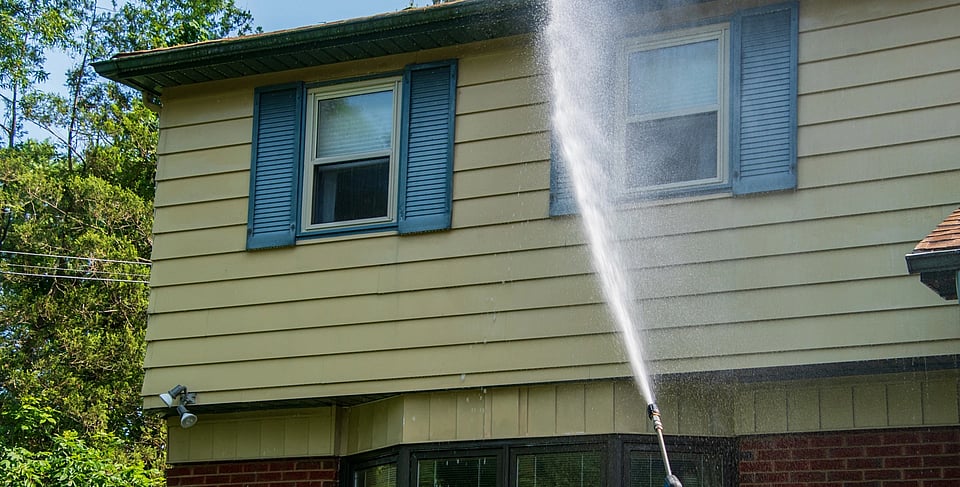
If you've ever looked at your home or business's exterior and thought it was time for a good cleaning, you've probably come across two terms: power washing and soft washing. On the surface, they might seem like two ways of describing the same thing - pointing a hose at a dirty surface and blasting it clean.
But in reality, these are two very different methods with very different applications, very different results, and in some cases, very different consequences for your home.
What Is Power Washing?
Power washing uses high-pressure water – often delivered at pressures between 1,500 and 4,000 PSI or higher – to physically blast dirt, grime, mold, and debris off surfaces. The defining characteristic of power washing is force. The cleaning action comes primarily from the mechanical pressure of the water itself rather than from any chemical treatment.
Power washing is best suited for hard, durable surfaces that can withstand intense water pressure without being damaged. Think concrete driveways, brick pavers, and certain types of commercial surfaces. When used correctly and on the right materials, power washing can be an effective way to remove heavy buildup, oil stains, and ground-in grime from surfaces that are built to handle the force.
However, power washing has significant limitations – and serious risks when applied to the wrong surfaces.
What Is Soft Washing?
Soft washing takes an entirely different approach. Rather than relying on brute water pressure to clean a surface, soft washing uses low pressure, high volume, and specially formulated cleaning solutions to break down and eliminate dirt, mold, algae, mildew, moss, lichen, and other biological growth at the source. The pressure used in soft washing is typically no higher than what comes out of a standard garden hose – meaning the cleaning work is done by the chemistry of the solution, not the force of the water.
This is a critical distinction. Soft washing doesn't just blast the surface appearance of contaminants away – it actually kills the organisms causing the discoloration and buildup, producing results that last far longer than pressure alone ever could. When the biological material is eliminated rather than just disturbed, it takes significantly longer to grow back.
Soft washing is the preferred method for cleaning:
- Home exteriors – siding, stucco, brick, painted surfaces, and wood
- Roofs – shingles, tiles, and metal roofing
- Asphalt driveways – which can be damaged or eroded by high pressure
- Decks and fences – particularly wood surfaces prone to splintering or warping under pressure
- Gutters and fascia boards
Can Power Washing Cause Damage to My Home or Business?
One of the most common and costly mistakes homeowners make is assuming that more pressure equals better results. In many cases, the opposite is true.
Applying high-pressure washing to asphalt shingles, for example, can strip away the protective granules on the surface, dramatically shortening the lifespan of a roof and potentially voiding manufacturer warranties. Directing high pressure at wood siding can force water into the wood grain, leading to warping, rot, and long-term structural damage. Even vinyl siding, which seems durable, can crack, warp, or have water forced behind it under high pressure – creating the conditions for mold and moisture damage inside your walls.
Soft washing eliminates these risks entirely by keeping the pressure low and letting the cleaning solution do the heavy lifting.
The Chemistry of Soft Washing
One area where soft washing truly separates itself from power washing is in the treatment of moss, lichen, and black algae mold spores – particularly the dark streaking commonly seen on roofs caused by gloeocapsa magma. This type of biological growth is not just unsightly. It actively feeds on the limestone filler in asphalt shingles, gradually breaking down roofing materials and reducing their effectiveness and lifespan.
Power washing can temporarily remove the visible evidence of this growth, but it does nothing to kill the spores – meaning the moss, lichen, or algae will simply grow back, often faster than before. Effective treatment requires specialized fungicides and herbicides applied through soft washing techniques.
Which Method Is Right for Your Home?
For most residential cleaning applications – home exteriors, roofs, asphalt driveways, decks, and fences – soft washing is the clear choice. It's safer for your surfaces, more effective against biological growth, longer-lasting in its results, and when performed by a properly credentialed professional, it delivers a level of clean that high-pressure methods simply cannot replicate.
Power washing has its place for certain heavy-duty concrete and hardscape applications, but it should never be the default solution for a home exterior or roof.
When it comes to protecting your home's surfaces and ensuring the job is done safely, legally, and effectively – credentials, equipment quality, and cleaning chemistry matter far more than raw water pressure. Choose a soft washing professional who brings all three to the job, and your home will show the difference for years to come.